
Choosing between plastic pulley wheels and metal pulley wheels is not simply a question of which material is “stronger.”
For B2B buyers, engineers, and equipment manufacturers, the better choice depends on load, working environment, noise requirements, wheel geometry, bearing arrangement, temperature, maintenance expectations, and total cost of ownership.
Plastic pulley wheels are widely used in sliding doors, windows, shower-door systems, furniture tracks, guide mechanisms, and selected light automation equipment. Metal pulley wheels remain important where higher mechanical strength, elevated temperature resistance, impact resistance, or greater structural rigidity is required.
For bearing-integrated pulley wheels, the wheel material is only one part of the design. Bearing quality, shaft fit, groove geometry, seals, grease, and installation conditions can have just as much influence on service life.
Quick Comparison: Plastic vs Metal Pulley Wheels
Choose plastic pulley wheels when low noise, corrosion resistance, lighter weight, smooth travel, and reduced wear on mating surfaces are important.
Choose metal pulley wheels when the application involves high structural loads, elevated temperatures, strong impact, or a need for maximum rigidity and dimensional stability.
Actual performance should never be judged by material name alone. Wheel diameter, groove profile, bearing type, shaft fit, housing support, material grade, operating temperature, contamination, speed, and duty cycle all affect the final result.
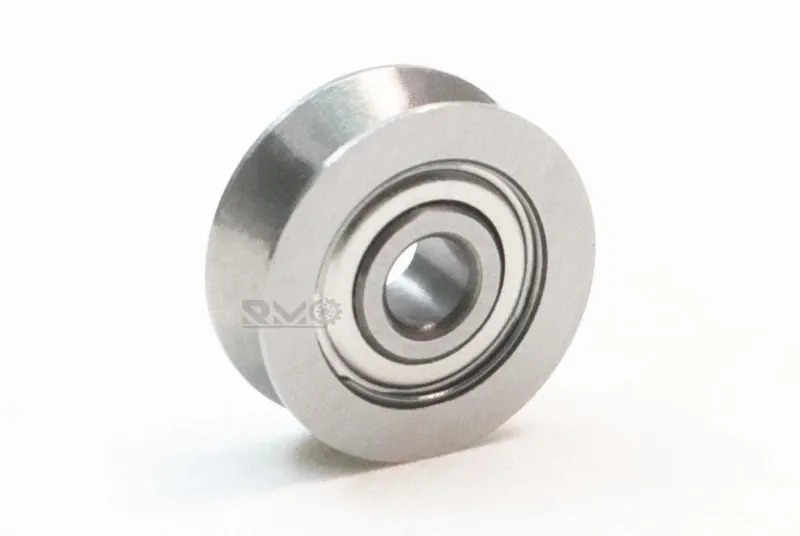
Nylon vs POM Pulley Wheels: What Is the Difference?
“Nylon pulley” and “POM pulley” are often grouped together as plastic pulley wheels, but the two materials do not behave exactly the same way.
As a general engineering guideline, nylon is often selected where toughness and impact resistance are important, while POM is commonly chosen where low moisture absorption, dimensional stability, and smooth sliding or rolling behavior are priorities.
However, the final result depends heavily on the exact material grade, fillers, additives, wheel geometry, load, temperature, and environment.
For OEM projects, buyers should therefore avoid specifying only “plastic.” It is better to confirm:
- Nylon, POM, or another engineering polymer
- Material grade
- Whether the polymer is reinforced or filled
- Operating temperature
- Humidity or water exposure
- Mechanical load and duty cycle
1. Material Differences in Real Applications
Plastic pulley wheels may be produced from nylon, POM, or other application-specific engineering polymers. Metal pulley wheels may use carbon steel, stainless steel, aluminum, or other alloys depending on the required strength and operating environment.
| Factor | Plastic Pulley Wheels | Metal Pulley Wheels |
|---|---|---|
| Weight | Lower mass can reduce inertia and make assemblies easier to move. | Higher mass and rigidity can be useful where structural stiffness matters. |
| Corrosion | Polymer wheel itself does not rust. | Carbon steel may require coating; stainless steel offers better corrosion resistance. |
| Noise | Engineering plastics can help reduce vibration and contact noise. | Rigid metal-to-metal contact may create more noise. |
| Track wear | Can be gentler on rails, tracks and mating surfaces. | Harder surfaces may increase wear on softer mating components. |
| Temperature | Limited by polymer grade and heat exposure. | Generally better suited to higher temperatures. |
| Structural strength | Suitable for many light-to-medium duty systems when correctly designed. | Preferred for high load, impact or rigidity requirements. |
2. Where Plastic Pulley Wheels Perform Best
Plastic pulley wheels are especially attractive when the mechanism must operate smoothly, quietly, and with limited maintenance.
Typical applications include sliding doors and furniture tracks, where low running noise and smooth movement are important; window and shower-door systems, where moisture resistance matters; guide rollers and compact mechanisms, where reduced wheel mass can help lower inertia; and selected light automation systems where repeated movement, noise, and weight are important design factors.
Plastic wheels can also help protect rails, tracks, cables, or mating surfaces from aggressive metal-on-metal contact.
However, “plastic” is not one single material. Nylon, POM, reinforced polymers, and other compounds respond differently to moisture, load, temperature, chemicals, and repeated cycling.
3. Where Metal Pulley Wheels Remain the Better Choice
Metal pulley wheels remain the better starting point when mechanical strength and structural stability dominate the application.
They are commonly considered for heavy mechanical loads, elevated temperatures, strong shock or impact, highly loaded narrow grooves, and systems where the pulley forms part of a rigid mechanical structure.
Metal does not automatically mean maintenance-free.
Carbon steel may corrode if surface protection is damaged. Stainless steel can improve corrosion resistance but may increase component cost. The final choice should therefore balance strength, environment, maintenance requirements, and total system cost.
4. Load Capacity: Material Alone Is Not Enough
Load capacity is one of the most misunderstood parts of pulley selection.
It is unsafe to assume that every plastic pulley has a low load capacity or that every metal pulley is suitable for heavy-duty service.
A small pulley wheel with a thin hub, unsuitable groove, or undersized bearing can fail even if the wheel material itself is strong.
Likewise, a well-designed engineering-plastic pulley wheel with the correct bearing, shaft, wall thickness, and groove geometry can perform reliably in many repeated-motion applications.
For technical evaluation, provide the supplier with:
radial load, axial load if applicable, wheel diameter, width, groove dimensions, bearing size, shaft size, speed, duty cycle, working temperature, installation method, and environmental conditions.
5. Bearing Selection Matters as Much as Wheel Material
For bearing-integrated pulley wheels, the bearing often determines running accuracy, noise, sealing performance, and long-term reliability.
Two pulley wheels with similar outside dimensions may behave very differently if they use different bearing clearances, seals, grease, fits, or internal quality levels.
For humid or dusty environments, sealed bearing options may help protect the raceways from contamination.
For low-noise systems, bearing quality, grease selection, wheel concentricity, shaft fit, and assembly accuracy all influence the final result.
This is why OEM buyers should evaluate the pulley wheel as a complete assembly rather than treating the wheel and bearing as unrelated components.
6. Corrosion, Humidity and Outdoor Exposure
The polymer body of a plastic pulley wheel does not rust, which can be useful in windows, shower doors, outdoor enclosures, and other damp environments.
However, a complete pulley assembly may still contain steel bearings, pins, rivets, screws, brackets, or shafts.
For applications exposed to moisture, buyers should confirm not only the wheel material but also:
bearing material, shield or seal type, fastener material, shaft material, and surface treatment of any metal components.
7. Noise and Running Smoothness
Plastic pulley wheels are often selected when noise reduction is important.
Engineering polymers can absorb vibration and reduce hard contact noise compared with rigid metal wheel surfaces.
However, wheel material is only one factor.
Poor concentricity, unsuitable groove geometry, excessive shaft clearance, contaminated grease, incorrect bearing fit, or assembly errors can create noise even when the wheel itself is plastic.
For sliding-door, furniture, window, and shower-door applications, sample testing under the actual rail profile and installation load is recommended.
8. Cost: Compare Total Ownership, Not Just Unit Price
The lowest purchase price does not always result in the lowest operating cost.
A pulley wheel that wears the track, corrodes, creates excessive noise, or requires frequent replacement can become expensive after installation.
Plastic pulley wheels may help reduce corrosion-related maintenance and can simplify lightweight assemblies.
Metal pulley wheels may justify a higher component cost when their rigidity, strength, or temperature resistance prevents premature failure.
OEM buyers should therefore compare service life, replacement labor, downtime, mating-surface wear, corrosion protection, and quality consistency—not only unit price.
9. Buyer Checklist: What to Confirm Before Ordering
Before requesting a quotation, confirm the wheel outside diameter, width, groove profile, critical tolerances, bearing specification, shaft or bore size, wheel material and grade, required radial and axial load, operating speed, cycle frequency, working temperature, moisture or chemical exposure, installation method, noise requirement, quantity, annual demand, and any OEM branding or dimensional requirements.
A drawing or physical sample is usually the best starting point for custom pulley wheel projects.
10. Plastic vs Metal Pulley Wheels: Final Selection Guide
| Your Priority | Better Starting Point | Why |
|---|---|---|
| Low noise / smooth travel | Plastic | Engineering polymers can reduce vibration and contact noise. |
| Humid environment | Plastic or corrosion-resistant metal | The polymer wheel does not rust, but metal components still need protection. |
| High temperature | Metal | Generally offers better structural stability at elevated temperature. |
| Very high load / impact | Metal | Higher rigidity and structural strength are easier to achieve. |
| Lightweight moving assembly | Plastic | Lower wheel mass can reduce inertia. |
| Track protection | Plastic | Engineering polymers may be gentler on mating surfaces. |
| Tight dimensional stability | Depends on material grade | POM, reinforced polymers, and metals should be compared based on the actual operating conditions. |
Frequently Asked Questions
Are plastic pulley wheels strong enough for industrial use?
They can be suitable for many light-to-medium duty industrial and mechanical applications.
The allowable load depends on polymer grade, wheel dimensions, bearing arrangement, temperature, shaft support, and duty cycle. Load capacity should be confirmed from the actual design rather than from the word “plastic” alone.
Which is better for sliding doors and windows?
Plastic pulley wheels are often a strong starting point because low noise, corrosion resistance, smooth movement, and track protection are usually important.
The final choice should still match the rail profile, installation load, bearing life, and environmental conditions.
Are metal pulley wheels always more durable?
Not necessarily.
Metal can provide higher rigidity and strength, but corrosion, lubrication, track wear, impact, and environmental exposure also affect service life.
Durability depends on the complete pulley design and operating conditions.
Can I replace a metal pulley wheel with a plastic pulley wheel of the same size?
Not automatically.
Matching outside dimensions is only the first step. The supplier should also confirm load, groove geometry, bearing fit, shaft support, temperature, speed, and surrounding structure.
What information should I send for an OEM pulley wheel quotation?
A drawing or sample is best.
Include wheel dimensions, material preference, bearing model, shaft or bore size, load, speed, environment, required tolerances, quantity, and any noise or branding requirements.
RMO Bearings: Bearing-Integrated Pulley Wheel Solutions
RMO Bearings supplies bearing-integrated pulley wheels and bearing solutions for applications including sliding doors, windows, shower doors, furniture systems, guide mechanisms, and selected light automation equipment.
We support RMO-branded products as well as sourcing based on customer specifications.
For custom pulley wheel projects, our team can review drawings, dimensions, wheel materials, bearing requirements, tolerances, and application conditions before quotation.
Need help selecting a plastic or metal pulley wheel?
Send us your drawing, sample, dimensions, load requirement, bearing specification, and target quantity.
Contact RMO Bearings:
https://rmbearing.com/contact-us/